
Psycophysics as a Field
Psycophysics is a research field that seeks to understand psychological reactions and perceptions to stimuli. As our understanding of psychology and the human brain further developed, we came to the realisation that our psychological reactions and perceptions from our senses can be influenced by many different factors [1]. These factors or variables can exist externally and internally, but can effect our subjective experience significantly. As such, psychophysics aims to understand this relationship, how senses and stimuli translate to our psychological reactions and experiences.
Extended Reality has been an novel avenue to conduct psychophysical experiments. It represents a new frontier in psychophysics research as it provides new mediums and stimuli to explore perceptions and psychology. Its immersive nature allows for a broader exploration of our existing senses, especially in terms of sight and hearing, but also more fine tuned senses such as our spatial awareness, balance, and proprioception. Additionally, it provides a good simulation tool, allowing easy replication of psychophysics experiments without the full logistics required [2]. A more fine tune control of stimuli and other research automotation tools such as data collection also allows for more intricate and complex research explorations. Therefore, the enhancements and opportunities extended reality provides to psychophysics researchers is plentiful.
Key terms
- Stimuli: An induced event that can be sensed by a user and elicit response.
- Condition: A set of stimuli presented simultaneously to a user that is unique to other stimuli combinations.
- Response: A human reaction to a stimulus.
- Threshold: The intensity at which a stimulus’s resulting response changes from present to absent (and vice versa)
Methods
In psychophysics, there is a set of standardised methods used for both the stimuli and the response.
Types of Response Measurement
To understand the response of a human given a stimuli, it is important to formulate what specifically is to be measured. All response measurements in psychophysics fall under the following two categories.
Subjective Measurement
A subjective reaction involving a users choice will be measured as the response. A predertemined set of answers is to be selected by the user, either through swtiches, buttons, discrete actions or verbally.
Objective Measurement
Biological and Physiological reactions are measured as the response. This can include heartbeats, brainwaves, eye tracking and other human responses. These will require usually specialised equipment to measure these responses accurately.
Types of Stimuli
Stimuli presented to users during psychophysics experiment can also vary. Selecting a reasonable choice in terms of types of stimuli helps us invoke an relevant response, and allows us to design our experiment appropriately.
Constant Stimuli
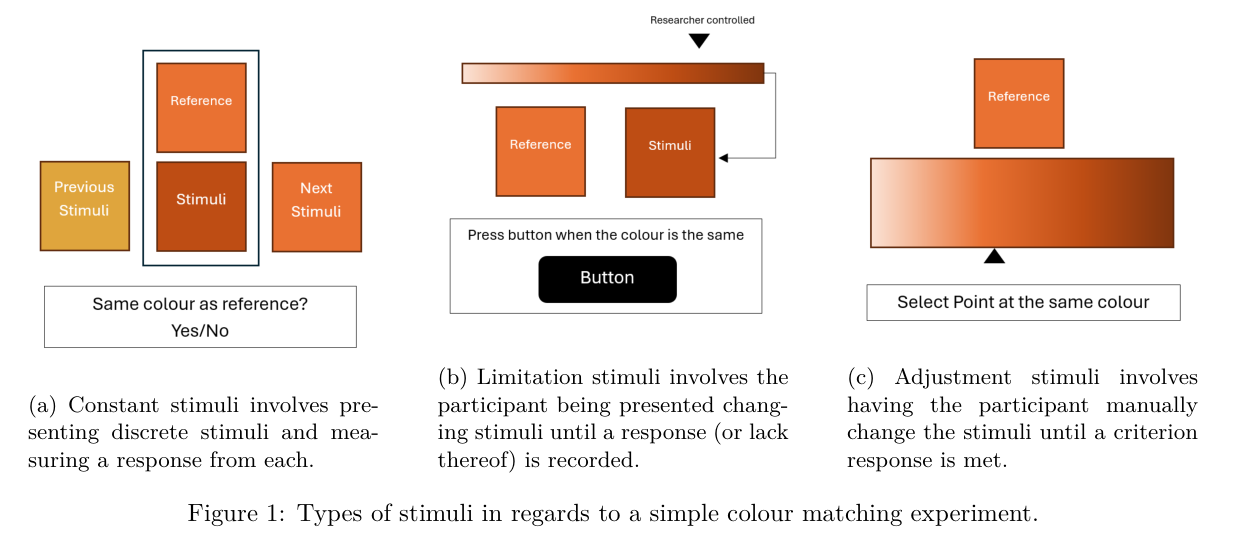
Discrete intensity and types of stimuli are prepared that are constant for each condition. Then, they are presented in a random order to the user.
Limitation/Threshold Stimuli
Gradual intensity increase/decrease is presented until the stimuli no longer evokes a response from the user. This intensity point of no response is then used to analyse the overall threshold of the stimuli.
Adjustment Stimuli
The participants manually alters the intensity and type of stimuli until a criterion has been met. This criterion is not restricted to responses, but can include other criterions.
Considerations
In the field of Psychophysics, there are key aspects that need to be considered that are perhaps unique to this field of research.
Human Ethics
Psychophysical experiments rely on human test subjects oftentimes. As such, it is incredibly important that the stimuli that you present does not cause adverse affects. Similarly, the method of measurement should also ensure participants safety. As humans are at the heart of psychophysics research, a rigorous ammount of ethics adherence is always required.
These ethics may need to be approved by an external board that can ensure that both the participants are not in harms way. They ensure that all the methodology and research findings are in line with moral and ethical standards, alongside regulations imposed by higher authorities. For example, the Toyohashi University Ethics Regulations are within effect for projects within the university. This regulation outlines the following key points:
- Human Rights: Respect human rights of all participants.
- Consent: Participants must understand the objective and risks and obtain written consent.
- Harm Minimisation: Experiments need to be designed to ensure safety and comfort for participants.
- Confidentiality: Obtained data needs to be private and secure.
- Data Management: Data needs to be stored appropriately for the future.
- Ethics Committee: Approval from the ethics committee is required to conduct the experiment
- Researcher Responsibilities: The researches must ensure compliance to ethical regulations and disclose any conflicts of interest.
- Monitoring and Reporting: Regular reporting and monitoring will be conducted to ensure compliance to regulations.
Participant Consent
As humans are at the heart of psychophysics experiments, participant consent is crucial and plays a major part in the ethics of the experiment. Participant should be given the choice of participating voluntarily, without any repercussions or negative impacts if they do not participate. It should also be reversible, meaning that the consent can be retracted at any time without any penalties nor repercussions. The consent should also be informed and specific. This means that the participant must know what is involved in the experiment and their expectations during conduction. They need to be informed of all their rights and responsibilities surrounding the experiment. In summary, consent in human experiment is a multi-faceted yet crucial aspect.
Due to the specificity of consent, it is a common practice to use a checklist or paper document to help outline all these information prior to the experiment. The document should include any information crucial for the participant to know. The document should have two copies, one for the participant to keep as proof of their participation, and one for the researcher to keep for future records.
Data Management
The data collected from a psychophyisical experiment needs to be treated with the upmost respect and consideration. Anonymity and security are very crucial, as leakage of experiment data may result in privacy breaches and unwanted consequences. It is also common to de-identify participants, so that privacy is maintained.
Besides privacy and security concerns, data quality is also something that needs to be considered. Adherance to psychophysical principles is ensures that the resulting data measured and collected is reliable. Additionally, ensuring that the storage of said data is maintained in a way to prevent corruption and mismanagement. By implementing this robust data management principle, it ensures the credibility of the data is upheld for not only the analysis step of the experiment, but also for future reserach.
Experimental Design
Several key aspects need to be considered for when conducting physchophysical experiments. These relate to how best to present stimuli and measure responses reliably.
A set of conditions need to be appropriately diverse between each other in terms of stimuli. This means ensuring that we are investigating multiple stimuli intensities and types within the framework of the experiment. However, it is usually important to understand the threshold of the stimuli such that we are investigating stimuli and responses that are interesting, because presenting stimuli of intensities that evoke the same response is less useful for researchers. Usually, a control condition is warranted for most psychophysics conditions. This control condition consists of non-existent or lowest intensity stimuli to measure the base response. This base response can now be isolated from other conditions responses, proving a more credible analysis.
Randomisation between conditions is also important in multi-conditioned experiments. This means, conditions should not be presented to all participants in the same order, as it can cause biases to form towards either the earlier or later conditions. Effects such as learning effect and fatigue effect effect conditions [3]. As such, randomisation ensures that data collected from a specific condition is not biased.
References
[1] Weber, E. H. (1846). De pulsu, resorptione, auditu et tactu. (Foundational work on psychophysics)
[2] B. de Gelder, J. Kätsyri, and A. W. de Borst, “Virtual reality and the new psychophysics,” British Journal of Psychology, vol. 109, pp. 421–426, May 2018. https://doi.org/10.1111/bjop.12308
[3] L. Fan, H. Li, and M. Shi, “Redirected walking for exploring immersive virtual spaces with HMD: A comprehensive review and recent advances,” IEEE Transactions on Visualization and Computer Graphics, vol. 29, pp. 4104–4123, 2022. https://doi.org/10.1109/tvcg.2022.3179269